
M2X with JFETs
This kit contains the amplifier PCBs, the PCBs for 5 different input stages, and the rare JFETs for the Ishikawa Input Stage
- 2 x M2x Amplifier PCBs - 25.5cm X 5.5cm. UMS Compatible.
- 2 x Ishikawa Input Stage PCBs
- 2 x Mountain View Input Stage PCBs
- 2 x Tucson Input Stage PCBs
- 2 x Austin Input Stage PCBs
- 2 x Norwood Input Stage PCBs
- 1 x Matched Quad of JFETs for the Ishikawa Input Stage
The M2x is based upon the Nelson Pass / First Watt M2 Amplifier. However, the first "buffer" stage of amplification has been placed on a removable daughter board, making it extremely easy to swap-in different first stage circuits. A total of five first stage circuit designs are provided, and naturally one of them is the Nelson Pass / First Watt original.
Read the M2X thread on diyAudio to learn more and join in the discussion.
The M2x is a Push-Pull Class A amplifier circuit, with zero global feedback. It consists of 3 stages: an input buffer circuit (on a daughter card), followed by a passive auto-transformer for voltage gain, and finally a Class A MOSFET push pull output buffer. The sound of the M2x, as Nelson Pass puts it, is "relaxed and lively."
Five different input stage options are provided on PCB daughter cards:
- ISHIKAWA: The Nelson Pass original using Toshiba JFETs
- MOUNTAIN VIEW: A single ended Class A circuit using a Fairchild JFET
- TUCSON: An IC opamp circuit using a highly regarded JFET-input chip from Burr Brown
- AUSTIN: A fully complementary, symmetric Diamond Buffer circuit using discrete bipolar transistors from ON Semi
- NORWOOD: An Analog Devices JFET opamp followed by a high bandwidth video driver (110 MHz!) from Harris
These different input circuit designs allow a builder many options, particularly when sourcing electronic components. For example, during times when the JFETs used in Nelson Pass's original (K170 + J74) are out of stock, one of the other daughter cards can be sourced, stuffed, soldered, and enjoyed in the listening room. Some early M2x builders report that they prefer the sound of these other cards, even more than the Nelson Pass original. Try them yourself and discover which one(s) YOU prefer.
How might someone choose which of these to build? (Or, which of these to build first?) Here are some thoughts.
ISHIKAWA (using Toshiba or LS JFETs) has the absolutely lowest parts count and is the easiest to solder together. But those FETs are hard to find.
TUCSON using the thru-hole OPA604 chip, is the lowest parts count board that doesn't use unobtainium devices. And the OPA604 opamp has JFET inputs, so if you love JFETs, it's one of the opamps you probably know and adore. Alternatively, TUCSON using the SMD OPA1611 chip, is the lowest distortion input stage of them all. Even lower than the Nelson Pass original. It only has one surface mount part; the rest of the board is thru-hole.
NORWOOD is all-SMD, just like the entire electronics industry has been for the last 20 years. Norwood includes a 200 mA driver IC, and a JFET input opamp from Analog Devices. Its output current capability is at least a factor of five greater than any of the other M2x input stages. If you're at all concerned about the input impedance of the output devices at HF, reflected from the transformer secondary back into the primary, Norwood can drive it better than all the others.
MOUNTAIN VIEW uses single-ended, class A, discrete circuitry and no feedback. If you are a big believer in single ended class A, if you love this quote from a famous article by Nelson Pass...
"For reproducing music as naturally as possible, push-pull operation is not the best approach. Air is not symmetric and does not have a push-pull characteristic. ... Only one linear circuit topology delivers the appropriate characteristic, and that is the single-ended amplifier. Single ended amplification only comes in pure class A,"
...then you probably are interested in listening to the Mountain View input stage.
AUSTIN is a thru-hole board with 4X more components than the other boards; its resistors are mounted vertically to save PCB area. This permits a Diamond Buffer circuit with high performance, precision current source loads. Builders who love parts substitutions / optimizations will appreciate that Austin's PCB silkscreen doesn't indicate transistor orientation. Instead, transistor pins are labeled B, C, E in a perfect circle; allowing you to drop in Japanese 2SA/2SC transistors (pinout ECB) or European BC transistors (pinout CBE) or American 2N transistors (pinout EBC) however you please. Austin is recommended ONLY for experienced builders. If you're a newbie, hire someone to solder your Austin board!!
Power supply requirements
A bipolar power supply of (+/- 24V) is required. The PSUs for almost all First Watt amplifiers including the F4, F5, F6, M2x, Aleph J, and Aleph Jzm are identical. The same PSU can be used for all of them.
There are three PSUs to choose from:
- Nelson's Bipolar Power Supply is the least expensive and easiest to build. It was designed to compliment the beautifully simple and inexpensive "minimalist" F5m.
- The Simple Linear Bipolar Power Supply is the choice for DIYers that prefer a higher performance power supply, but enjoy the convenience of a full kit. For builders that prefer to choose their own parts, the PCBs are also available.
- The Universal Power Supply PCBs allow the experienced DIYer to choose every part of their PSU or use what they have in their spare parts bin.
Chassis suggestions
The 3U Deluxe is an excellent choice. For builders that want more space and/or may want to build a bigger amplifier in the future, the 4U Deluxe or 5U Deluxe are great choices. We also have a back panel parts kit to make life easier, and don’t forget the Keratherm.
Output Power
As with most First Watt amplifiers, the power output is 25WPC into 8 ohms.
I've built the Aleph J and F6 prior to the M2x. Each time, the boards were top quality. The build guides and member assistance from the forum are just fantastic. The M2x is my favorite of the 3, so far having only tried the Ishikawa input stage. In fact, it's the best sounding amp I've ever had.
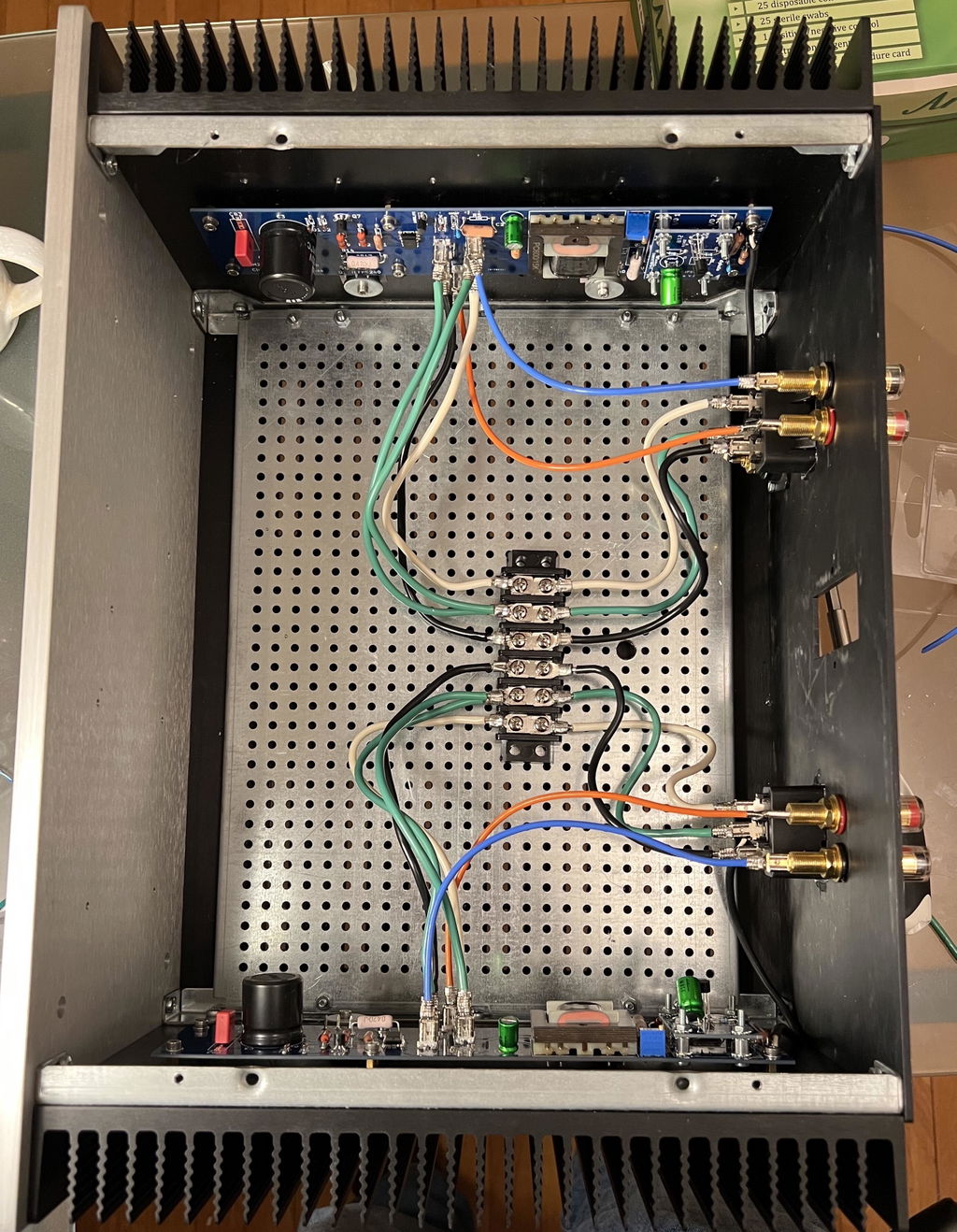
Great boards. I made a mistake in the assembly. Removal and rework of the part caused absolutly no damage to the board. Many cheap boards would not have fared so well.
__original.jpg?quality=80&width=1024)
My M2X is still in progress. So I can`t tell you how the different input boards affect the sound.
PCBs are very good quality (as always!). Delivery was very fast. But customs take their time
(it was around christmas time!).
I am very pleased with the possibilities to change the input boards. Nice toy to play with.
Unusually I got the EDCOR-transformers first, then the pcbs, and still waiting for some
other parts.
Thanks to
Nelson Pass, Mark Johnson, 6L6 and all other involved persons...
Greets from Germany
Dirk
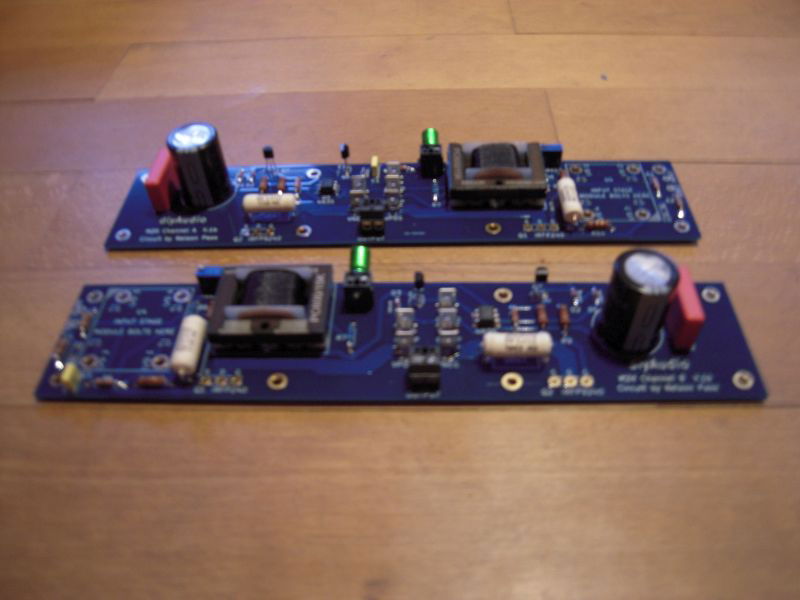
Arrived in perfect order. Boards well
Made. Have not had a chance to start work as yet.
These boards are fine by themselves and represent a rare opportunity for DIYers: take advantage of a superb Pass design that has been augmented by Johnson's fine daughterboard concept. Great stuff all around.
The problems anyone will have are related to the difficulty of obtaining certain parts. The trimpot is currently backordered everywhere and a substitute must be tried. Fortunately, Edcor is making the transformers available and this company is pleasant to deal with.
What is needed is the flexibility to order one or another board individually. Problems can occur and when a board is ruined, an entire set must be purchased just to replenish that one ruined board.
Those of us that have taken advantage of the M2x thread, with OP Johnson, know how helpful this crew is. An exceptional group of fine professionals helping folks they don't even know -- KUDOs, DIYers!
Boards are standard DIYAudiostore boards, they are excellent quality. The amp is exceptional! It is one of the best sounding i have had the pleasure of listening to in my room with my system.